Australia’s property market has entered a very different phase in 2026.
After several years of strong price growth, higher interest rates, tighter borrowing capacity and changing investor conditions have started to take some heat out of the market.
At face value, falling property prices may not sound like an ideal time to invest.
But for investors with the right strategy, the current market could present an opportunity.
Less competition, softer prices, greater negotiating power and continued rental demand are creating a very different environment from the highly competitive market investors faced only 12–18 months ago.
The key is understanding where the opportunities are and buying based on the numbers — rather than trying to predict the exact bottom of the market.
Is now a good time to buy an investment property?
There is no single answer for every investor or every location.
However, the latest August 2026 data suggests that buyers in many parts of Australia have more negotiating power than they did previously.
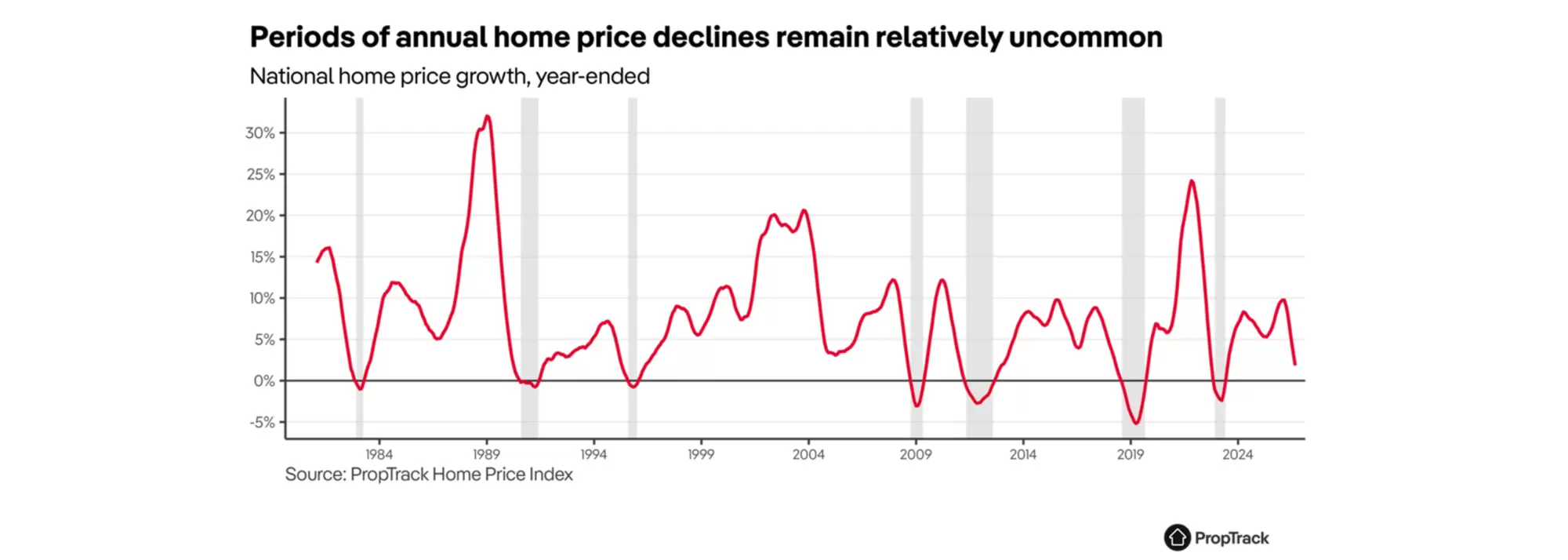
According to the August 2026 PropTrack Home Price Index, national home prices fell 0.2% in August, marking the fifth consecutive monthly decline. Prices are now 2.7% below their March 2026 peak, while combined capital-city prices are 3.6% below their peak.
That does not mean every property or every market is falling.
Regional markets have been considerably more resilient, while some capital cities have experienced larger corrections. Sydney prices were 4.9% below their peak in August, while Melbourne was 5.3% below peak.
For investors, this distinction matters.
The opportunity isn't simply to "buy because prices are down". It is to identify markets and properties where the fundamentals still make sense while taking advantage of a more favourable negotiating environment.
1. Buyers have more negotiating power
One of the biggest changes in the market is the balance between buyers and sellers.
Cotality's August 2026 Housing Chart Pack showed that homes were taking a median 35 days to sell, while the national median vendor discount had widened to 3.8%.
Auction clearance rates had also fallen into the low 40% range by the end of July, compared with around 66% earlier in the year.
That creates an environment where investors may have more opportunity to negotiate.
Instead of competing against multiple buyers and paying a premium simply to secure a property, buyers can potentially take a more measured approach.
That could mean negotiating:
- A lower purchase price
- More favourable settlement terms
- Repairs or inclusions
- Longer due-diligence periods
- Better overall purchasing conditions
The opportunity isn't necessarily finding a "cheap" property. It's buying a good property without having to overpay for it.
2. Falling prices can improve the starting position
Investors don't need property prices to surge immediately for an investment to make sense.
The purchase price is one of the most important variables in the equation.
Buying at $750,000 rather than $800,000, for example, can have a meaningful impact on:
- Loan size
- Deposit requirements
- Interest costs
- Stamp duty
- Rental yield
- Cash flow
- Long-term capital growth potential
This is why market conditions matter.
If buyer competition is lower and sellers are more willing to negotiate, an investor who is financially prepared may be able to secure an asset at a better entry point than they could during a stronger market.
The important distinction is that lower prices alone don't make a property a good investment.
Location, rental demand, property quality, borrowing structure and long-term growth prospects still matter.
3. Rental demand remains a key investment driver
While property values have softened, the rental market has not experienced the same level of weakness.
Cotality's August 2026 data showed national advertised rents had increased 5.9% over the year to July, while the national rental vacancy rate remained low at around 1.7%. Gross rental yields across the combined capitals had also increased to around 3.7%, the highest level since 2019.
This creates an interesting dynamic for investors:
Property values are easing while rents remain elevated.
That can improve the relationship between the property's purchase price and the income it generates.
Of course, rental growth isn't uniform across Australia, and investors shouldn't buy purely because rents are rising.
But in locations with strong employment, population growth, limited rental supply and consistent tenant demand, rental fundamentals can provide an important buffer.
4. The market is becoming more affordable in some areas
The August PropTrack data also highlights an important shift in what buyers can afford.
Nationally, unit prices have been outperforming houses.
Unit prices were 3.0% higher than a year earlier, compared with 1.5% annual growth for houses. Units have also experienced a smaller correction from their peak.
Why?
Affordability.
As borrowing capacity comes under pressure, buyers are increasingly looking at more affordable property types.
For investors, this can create opportunities to consider properties that may have previously been overlooked — particularly well-located units and other lower-entry-price properties with strong rental demand.
The lesson isn't that units are automatically better investments.
It's that affordability is becoming an increasingly important factor in determining which parts of the market continue to attract demand.
5. Housing supply remains an important long-term consideration
Australia continues to face a structural challenge around housing supply.
The latest ABS data released in September showed 17,687 dwellings were approved in July 2026, down 3.6% from June but still 9.0% higher than a year earlier. Private-sector house approvals fell 4.2% during the month.
This is important because it shows the supply story is more nuanced than simply saying "Australia isn't building enough homes."
Approvals are still occurring, but construction remains constrained by factors including financing costs, construction costs, labour availability and development feasibility.
For investors, the longer-term question is therefore not just how many homes are being approved.
It is where those homes are being built, what type of housing is being delivered and whether supply is keeping pace with population and rental demand in individual markets.
That makes location selection increasingly important.
6. Australia's property market isn't moving as one market
One of the biggest mistakes an investor can make right now is treating Australia as a single property market.
The August data shows significant differences between locations.
PropTrack reported that in August:
- Sydney prices fell 0.3%
- Melbourne fell 0.2%
- Brisbane fell 0.3%
- Adelaide fell 0.9%
- Canberra fell 0.4%
- Darwin increased 0.1%
- Regional prices were unchanged
Regional prices also remained 6.6% higher than a year earlier, compared with just 0.2% annual growth across the combined capitals.
That divergence creates an important opportunity for investors.
Rather than asking:
"Is Australian property going up or down?"
A better question is:
"Which markets have the strongest combination of affordability, rental demand, supply constraints and long-term growth potential?"
That's where research and strategy become more important than headlines.
7. Waiting for the bottom can be difficult
One of the biggest challenges for investors is trying to perfectly time the market.
Could prices fall further?
Absolutely.
PropTrack expects further pressure on home prices in the coming months, particularly across capital cities, with interest rates and borrowing capacity remaining important factors.
But nobody knows exactly when the market will reach its lowest point.
By the time the bottom is obvious, buyer competition may already have returned.
For long-term investors, the goal should generally be less about picking the exact bottom and more about finding a property that makes sense at today's price.
If the numbers work, the rental demand is strong and the property has the right long-term fundamentals, waiting indefinitely for another 5% or 10% reduction may not necessarily produce a better outcome.
What should investors look for in the current market?
The current environment rewards investors who do their homework.
Rather than focusing solely on capital growth forecasts, consider:
1. Rental demand
Look for areas with strong tenant demand, limited rental supply and diverse employment drivers.
2. Purchase price
Compare the property's price against comparable sales rather than relying solely on the vendor's expectations.
3. Rental yield
Understand the gross and net yield and how the property performs after interest, management, maintenance, insurance and other costs.
4. Borrowing capacity
Make sure the investment remains sustainable if interest rates remain higher for longer.
5. Supply
Research existing and proposed developments that could increase competition for tenants.
6. Long-term fundamentals
Look beyond short-term price movements and consider population growth, infrastructure, employment, amenities and accessibility.
7. Property quality
A cheaper property isn't necessarily a better investment. The quality, location and tenant appeal of the asset still matter.
So, should you buy an investment property now or wait?
For some investors, waiting may make sense.
For others, the current market could represent a much better buying environment than the highly competitive conditions of recent years.
The difference comes down to your financial position, borrowing capacity, investment strategy and the property you're buying.
The August 2026 data tells us something important:
The market has softened, but the fundamentals haven't disappeared.
Prices have fallen in many markets, buyers have more negotiating power and rental demand remains relatively strong.
That combination can create opportunities for investors who are prepared to act strategically.
The opportunity isn't about buying at the bottom
The goal shouldn't be to predict the exact day the property market stops falling.
Instead, focus on buying an asset that makes sense based on:
Purchase price + rental income + cash flow + location + long-term fundamentals + finance structure.
If those numbers work today, a softer market can potentially become an advantage rather than a disadvantage.
For investors with the right strategy, less competition can mean more choice, more negotiating power and potentially a better entry point.
And that is why the current market deserves a closer look.
Thinking about buying an investment property?
At Harrow & Co, we help investors assess their borrowing capacity, compare loan options and structure finance around their broader investment strategy.
Whether you're purchasing your first investment property or adding to an existing portfolio, the right finance structure can make a significant difference to the outcome.