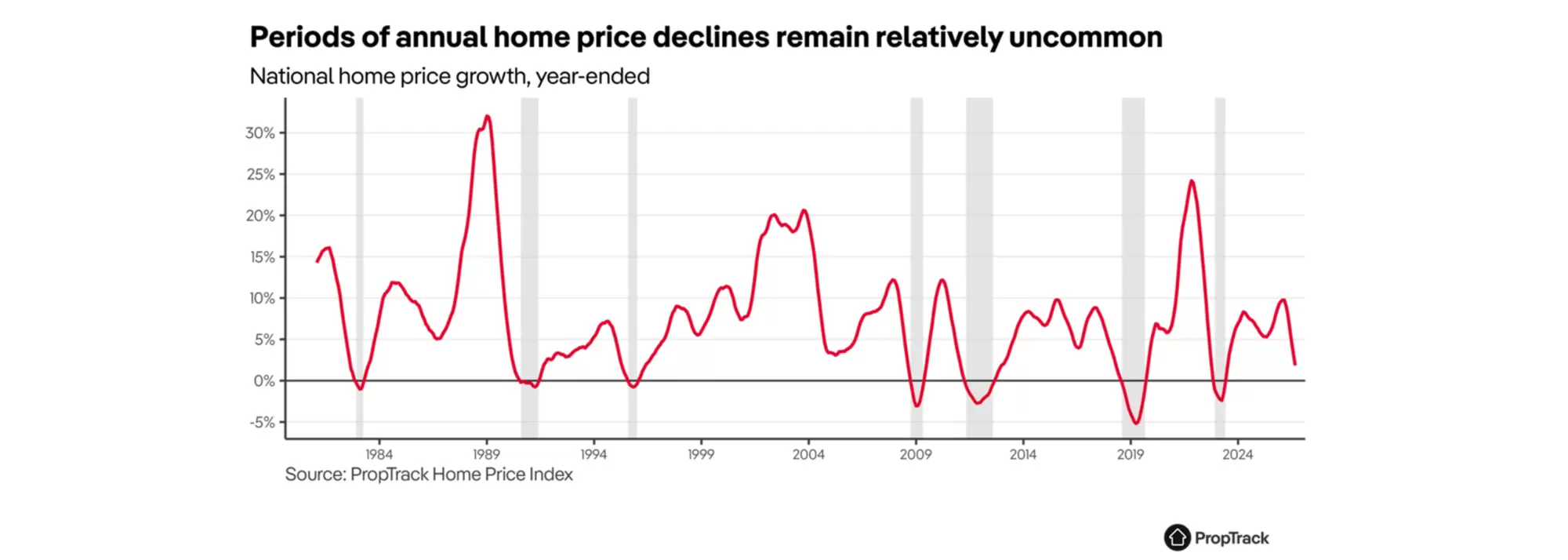
The Australian property market is entering a very different phase.
After a period of strong price growth, higher interest rates and changing economic conditions are putting pressure on property prices across parts of Australia. Three of Australia's four major banks, CBA, NAB and ANZ, are currently forecasting at least one more interest rate increase in 2026.
For many buyers, this creates uncertainty.
For property investors, however, it could also create opportunity.
The question isn't necessarily whether property prices will fall further. The more important question is whether the current market is creating opportunities for investors who have the right strategy, finance structure and long-term outlook.
What Is Happening in the Australian Property Market?
The Australian property market is currently experiencing a period of correction.
Recent market data shows that property values have been falling across a large number of Australian suburbs, with Sydney and Melbourne among the markets experiencing some of the sharpest declines. CBA has forecast a potential national peak-to-trough decline of around 9%, with larger falls possible in Sydney and Melbourne.
Higher interest rates are one of the key factors contributing to the change in market conditions.
When borrowing becomes more expensive, borrowing capacity generally falls. Buyers become more cautious, competition can reduce and vendors may need to adjust their price expectations.
This can create a very different environment from a rising property market.
And that is where property investors need to start looking beyond the headlines.
Why Interest Rates Matter for Property Investment
Interest rates have a significant impact on property investment in Australia.
Higher interest rates can affect:
- Borrowing capacity
- Investment property loan repayments
- Cash flow
- Rental yield requirements
- Investor confidence
- Property demand
- Development feasibility
The Reserve Bank of Australia uses interest rates as one of its primary tools for managing inflation and economic activity.
When inflation remains persistent, rates can stay higher for longer or potentially increase further.
That can put pressure on the Australian property market.
But interest rates don't move in one direction forever.
Eventually, economic conditions change, inflation can moderate and the rate cycle can turn.
For property investors, understanding where the market sits within this broader cycle can be more valuable than trying to predict the exact date of the next rate move.
Could Falling Property Prices Create an Opportunity?
This is where property investment becomes particularly interesting.
When the Australian property market is rising strongly, investors often face significant competition.
Properties can attract multiple offers. Auctions can become highly competitive. Vendors have greater negotiating power.
When the market slows, the balance can shift.
Investors may have more time to conduct due diligence, negotiate with vendors and identify properties that would have been difficult to secure during a boom.
The objective isn't to buy simply because prices have fallen.
It is to identify quality property at a sensible price that fits a long-term investment strategy.
That distinction is important.
A cheap property isn't necessarily a good investment.
A well-located property with strong underlying demand, sensible fundamentals and an appropriate purchase price may be a far more attractive opportunity.
Should You Wait for the Bottom of the Property Market?
One of the most common questions investors ask is:
"Should I wait until property prices hit the bottom?"
The problem is that nobody knows when the bottom has occurred until after the fact.
If you wait until the market is clearly recovering, prices may already be rising and competition may have returned.
This is one of the biggest challenges with trying to time the Australian property market.
Instead of trying to pick the exact bottom, investors can focus on:
- Buying quality assets
- Purchasing at a reasonable price
- Understanding the local market
- Maintaining sufficient cash flow
- Structuring their investment property loans appropriately
- Taking a long-term approach
This approach removes some of the pressure associated with trying to perfectly time the market.
The Australian Housing Supply Problem
There is another factor that property investors should consider: supply.
Australia continues to face challenges around housing supply and affordability.
While building approvals can fluctuate from month to month, the latest ABS data shows that total dwelling approvals fell 3.6% in July 2026, while private sector house approvals fell 4.2%.
The economics of construction are also important.
Builders and developers need projects to be financially viable.
If the combined cost of land, labour, materials, finance and construction becomes too high relative to the expected selling price, developers may delay or abandon projects.
This can reduce future housing supply.
At the same time, population growth continues to create demand for housing.
This creates a structural challenge for the Australian property market.
A short-term decline in property prices does not necessarily remove the underlying need for housing.
Why Replacement Cost Matters
Consider what happens if an existing home can be purchased for significantly less than the cost of building an equivalent new property.
Over time, that gap can become increasingly difficult for the construction industry to absorb.
If builders cannot make a reasonable return, they have less incentive to build.
Fewer new homes can ultimately mean tighter supply.
This is one reason why investors should consider more than just the headline property price when assessing the Australian property market.
The underlying economics of housing supply matter too.
What Happens When Interest Rates Eventually Stabilise?
Property markets can respond quickly when interest rate expectations change.
When buyers believe interest rates have peaked, confidence can begin to return.
When rates eventually fall, borrowing capacity can improve.
Buyers who were previously waiting may return to the market.
Investors who had delayed purchasing decisions may start looking again.
And this can increase competition.
This creates an interesting dynamic for property investors.
The period immediately before a market turns can look very different from the period immediately after it turns.
By the time the recovery is obvious, some of the best buying opportunities may have already disappeared.
Investment Property Loans: Why Your Finance Structure Matters
Buying the right property is only one part of successful property investment.
How you finance the property can be equally important.
Investment property loans need to be considered within the context of your broader financial position and future investment plans.
The right loan structure can influence your:
- Borrowing capacity
- Cash flow
- Interest costs
- Ability to access equity
- Ability to purchase additional properties
- Long-term portfolio strategy
For example, an investor purchasing their first investment property may have very different lending requirements from someone who already owns several properties.
This is why there is no single "best" investment property loan for every borrower.
Your income, existing debts, property portfolio, equity position and future plans all need to be considered.
How Much Can You Borrow for an Investment Property?
Before searching for an investment property, one of the first questions to answer is how much you can realistically borrow.
Your borrowing capacity can be influenced by factors including:
- Income
- Existing home loans
- Credit commitments
- Living expenses
- Existing property values
- Rental income
- Interest rates
- Lender assessment policies
- Deposit and available equity
Understanding this before you start looking can help you establish a realistic investment property budget.
It can also help you move quickly when the right opportunity comes along.
[Internal link: Investment Property Loans]
Property Investment Is About More Than Buying at the Right Time
Market timing is only one component of successful property investment.
The bigger picture is your overall strategy.
A successful investment strategy should consider:
The property:
Is there strong underlying demand and a reason people will want to live there?
The location:
Are there economic, infrastructure, employment and population drivers supporting the area?
The numbers:
Does the rental income make sense relative to the purchase price and holding costs?
The finance:
Is the investment property loan structured appropriately for your circumstances?
The long-term plan:
Does this property help you move towards your broader investment objectives?
This is where professional advice can add significant value.
Is 2026 a Good Time to Invest in Property?
There is no universal answer.
The right time to invest depends on your individual financial position, investment strategy and risk tolerance.
However, the current Australian property market is creating conditions that are worth paying attention to.
Prices are under pressure in many markets, buyer competition has reduced and interest rate expectations remain a major influence on sentiment. At the same time, housing supply remains an important structural issue.
For investors with the financial capacity and a long-term outlook, periods like this can provide opportunities that may not exist during a rapidly rising market.
The key is being prepared.
What Should Property Investors Do Now?
Rather than trying to predict exactly what happens next, investors can use this period to get their position ready.
1. Review your borrowing capacity
Understand what you can realistically borrow under current lending conditions.
2. Review your existing loans
If you already own property, review your current loan structure and determine whether there are opportunities to improve your position.
3. Understand your available equity
Equity in an existing property may potentially be used to help fund another investment, subject to lender requirements and your overall financial position.
4. Define your investment strategy
Determine what type of property, location and investment outcome you're targeting before you start searching.
5. Get finance ready
Having your lending strategy in place can put you in a stronger position when the right property becomes available.
The Bottom Line for Property Investors
Nobody knows exactly where the Australian property market will be in six or twelve months.
There may be further price falls.
Interest rates could rise again.
The market could stabilise sooner than expected.
What we do know is that property markets are cyclical.
Periods of uncertainty can create opportunities for investors who are prepared to act when the right opportunity presents itself.
The objective shouldn't be to perfectly predict the bottom.
It should be to understand the market, identify quality opportunities and make sure your finance is structured to support your long-term property investment strategy.
Ready to Explore Your Property Investment Options?
At Harrow & Co, we help investors understand their borrowing capacity, explore investment property loans and structure finance around their broader property investment goals.
Whether you're considering your first investment property, looking to expand an existing portfolio or simply want to understand what's possible, the first step is understanding your financial position.
Don't wait until the market feels certain. Get your position ready now.
Speak with Harrow & Co today to discuss your property investment strategy and explore your investment property loan options.
[CTA: Speak With Harrow & Co →]
Frequently Asked Questions About Property Investment in Australia
Is now a good time to invest in Australian property?
There is no single answer that applies to every investor. Current market conditions may create opportunities for buyers who have a strong financial position, a long-term investment strategy and the ability to purchase quality property at sensible prices.
Will property prices fall further in Australia?
Property prices could fall further in some Australian markets, particularly while higher interest rates continue to affect borrowing capacity and buyer confidence. However, property markets vary significantly between cities, suburbs and property types.
Should I wait for property prices to fall before investing?
Trying to predict the exact bottom of the Australian property market is extremely difficult. Rather than waiting for a specific price point, investors can focus on finding quality assets at reasonable prices and ensuring the investment works financially over the long term.
What are investment property loans?
Investment property loans are home loans used to purchase property intended to generate rental income or form part of an investment portfolio. The lending criteria, interest rates and available loan structures can differ from owner-occupier lending.
How much deposit do I need for an investment property?
The deposit required can vary depending on the lender, property, loan structure and your financial circumstances. Some investors may also be able to use equity in an existing property as part of their funding strategy.
Can I use equity to buy an investment property?
Potentially. If you have sufficient usable equity in an existing property, a lender may allow you to access some of that equity to contribute towards another property purchase, subject to lending criteria and serviceability.
What should I consider before buying an investment property?
Investors should consider the purchase price, location, rental demand, expected rental income, ongoing costs, borrowing capacity, investment property loan structure, tax implications and long-term investment objectives.
Should I speak to a mortgage broker before buying an investment property?
Speaking with a mortgage broker before starting your property search can help you understand your borrowing capacity and available lending options. It can also help you establish a finance strategy before you make an offer.